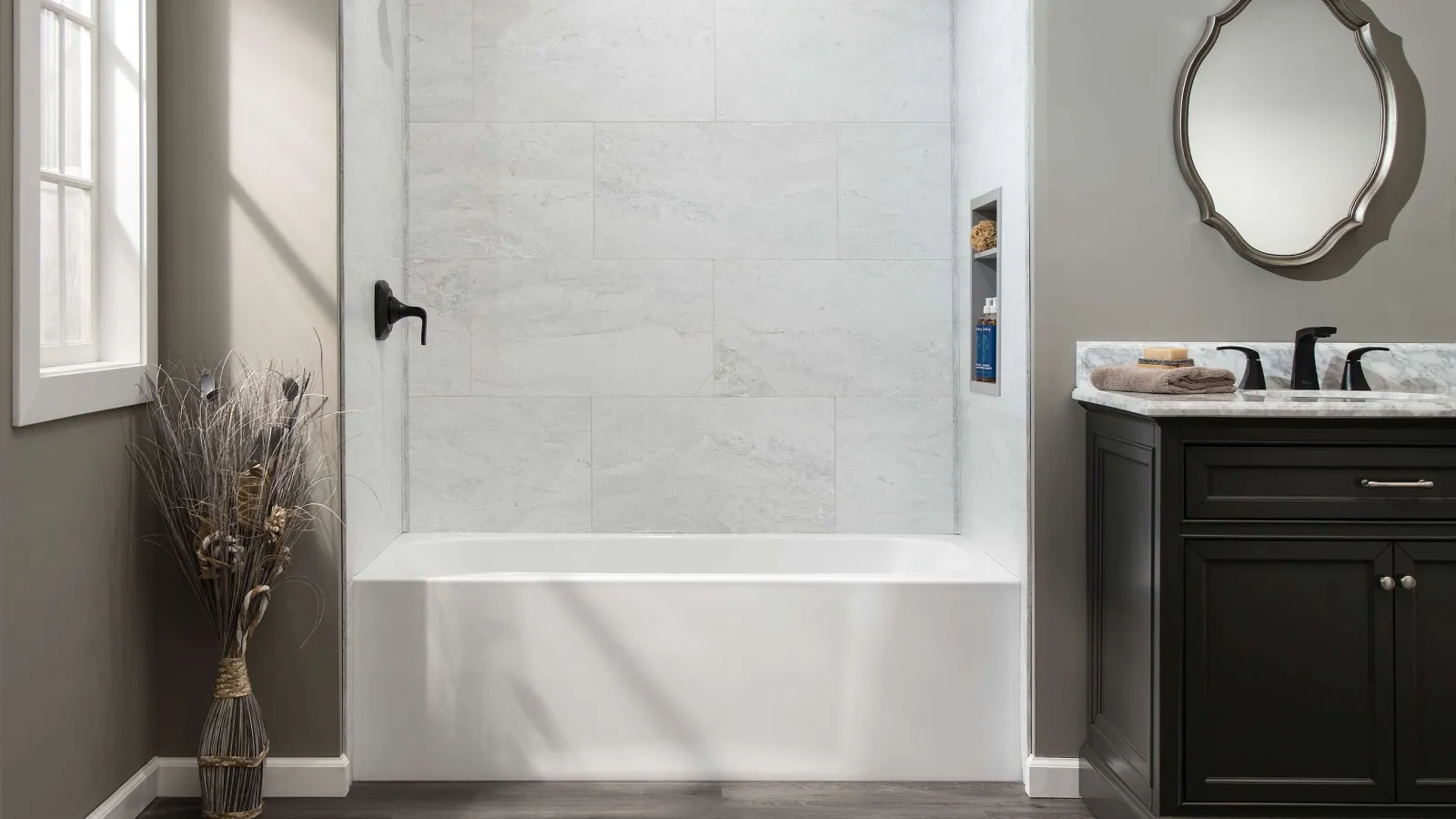
Modern bathroom with white bathtub, dark wood vanity, decorative mirror, and wood-look flooring under natural light.

Wall Plank Installation

Wall Plank Installation Guide

25min Read
DIY Experience Recommended
Download PDF

READ this entire installation guide before beginning your installation.

ACP is not responsible and will not be held liable for project failures if installation guidelines are not followed. ACP recommends that you install these tiles over an existing substrate to ensure proper structural integrity. Palisade tiles are not intended to be attached to raw concrete, poured concrete walls or concrete block basement walls.

FOR INSTALLATION IN DRY ENVIRONMENTS

Appropriate substrates in a dry environment would include framed walls with existing tile, drywall, cement board, OSB, or plywood. Palisade tiles must be attached to structures that comply with your local building codes and have incorporated appropriate moisture abatement measures.

Cozy bedroom with teal bedding, decorative pillows, wooden accent wall, hanging lamp, and small bedside table.

FOR SHOWER, TUB OR DIRECT WATER ENVIRONMENTS

Although Palisade tiles are 100% waterproof when used with sealant in the seams, we recommend you follow your local building codes for wet environments like shower and tub enclosures. In a tub or shower area, existing ceramic tile walls can be covered with no additional preparation. Otherwise, installation over a waterproof substrate is required, such as Cement Board®, Schluter Kerdi Board®, GP Densheild®, Johns Manville Go Board®, Hardiebacker®, WPBK Triton®, Fiberock® and equivalent products. Always follow manufacturer's installation instructions to create a waterproof enclosure.
Modern shower setup with black rain showerhead, wooden bench, green plant, and wood-like tile walls.

FOR BACKSPLASH, LAUNDRY ROOM OR OTHER DAMP ENVIRONMENTS

We recommend using a silicone sealer in the tile's tongue and groove seams for damp environments. Follow manufacturer's directions and your local building code ACP, LLC is not responsible or liable for any labor costs or damaged product incurred as a result of improper installation. All product defects are covered under our 10-year limited warranty.

Due to manufacturing variations, we cannot guarantee an exact color match from lot to lot. Prior to installing Palisade tiles and trims on your walls, please unpackage & lay out all purchased product to ensure color consistency. If you encounter unreasonable color variation, please give us a call at 1-800-434-3750 (7am-4:30pm CST, M-F) so that we may assist you with your project.

Modern laundry room with front-load washer and dryer, towels, sink, and decorative shelf with plants and signs

Tools and supplies needed:

  • Protective eye wear
  • Measuring tape
  • Utility knife
  • Level
  • Hand saw or circular saw/table saw
  • Drill bit & jig saw (for cutting holes)
  • Caulking gun for 10.3 oz. adhesive tube
  • Adhesive for PVC panels. Recommended adhesives: Loctite® Power Grab® Ultimate (white formula only), Titebond® Titegrab Ultimate®, Liquid Nails® Fuze It® and Manus® 75-AM HV
  • Silicone-based sealant
  • Optional: Matching trim
  • Optional: Wood shims
Set of yellow and black carpentry tools including safety glasses, measuring tape, level, saws, drill bit, utility knife, and caulking gun.

Before you begin installation

Before starting, make sure all surfaces are clean, dry, smooth, and free from dust, grease, wax, etc. Clean the back surface of the panels by wiping with a clean cloth. Perform a "dry layout" prior to applying adhesive. This will help you visualize tile cuts and placement of tiles with similar designs. Some of the stone-look tiles include color variations, lines, and cracks to emulate the look of natural stone. Avoid placing tiles with similar or identical patterns or texture next to each other. Measure walls, & check for level and square. Depending on dimensions and room construction, you may need to trim some panels accordingly.

Installation in environments exposed to a direct flow of water (shower, mud room or garage) require a 1/8-inch bead of sealant to be used in all tongue and groove connections (image A). Add a bead of the sealant along recently cut edges to be placed into the corner. Repeat this process on perpendicular plank also facing corner (image B).

A

Person applying white sealant from a tube to gap between wood-patterned floor tiles and a gray wall.

B

Person applying white sealant with caulking gun to the corner of wood-textured tiled wall.

Cut Palisade tiles by scoring and snapping with a utility knife. (image C, D).

This method may require sanding the snapped edges. You can also use standard wood working tools like a table saw or circular saw with a fine-tooth blade to provide a clean, smooth cut (image E). Use a 60-tooth blade or higher. To ensure the base of the saw does not scratch the surface of the panel, we recommend protecting the surface with blue painter's tape.

Cut panels for outlets and light switches. Measure and mark the borders where the opening will be with a marker. Drill a 1/2-inch hole using a drill in a corner of the cut-out section (image F). Use a jigsaw to cut the remaining opening, following your tracing (image G). Do not attach accessories like coat hooks, light fittings, mirrors, etc. directly to the tiles. Drill holes through the tiles and use suitable anchors to attach the accessories securely into the framing behind. Seal per sealant instructions.

C

Person cutting vinyl plank flooring with utility knife and metal ruler on wooden surface

D

Person fitting gray wood-look vinyl flooring planks on a table over stone-tiled floor background

E

Close-up of a Ridgid circular saw cutting through a piece of wood with visible motion blur on the blade.

F

Person using a yellow and black drill to make a hole in a marked rectangular shape on a wooden plank.

G

Close-up of a hand using an orange jigsaw to cut a marked pattern on gray laminate wood flooring.

Installation onto drywall, OSB, plywood or existing tile subtrates

If you choose to finish the edges, we recommend our matching trim for both end pieces and inside corners. We recommend using baseboard or cove molding to finish the bottom row, regardless of flooring material. For both end trim pieces and corner trims, install trim in appropriate location prior to setting plank into trim (image H). Palisade planks' unique interlocking edges have a tongue and a groove (image I). The plank's groove should be facing up when installing. This will prevent any moisture buildup.

If your project calls for Palisade planks starting at a floor, be sure the first row is straight and level. Determine the desired height of your first plank row and snap or draw a level line at that height for a reference line. Align the tops of each panel in the first row to the snapped line (image J). It is important that this starting row be level and straight. If you are starting with full plank, cut off the tongue or use a matching J-trim along the bottom edge.

H

Hands installing gray wood laminate flooring on a smooth gray surface in a close-up view.

I

Close-up of tongue and groove wood panels showcasing the interlocking joint design for flooring or paneling.

J

Close-up of a wooden floor panel placed on a gray concrete floor showing texture and grain details.

To install your first plank, begin with bottom row.

Make sure the first panel you intend to install fits properly and is level. You may need to place a temporary shim under each bottom plank to hold them in place while the adhesive sets (image K). Apply adhesive to the back of the plank. Carefully read and follow adhesive manufacturer's directions. Apply a 1/4-inch bead in a typical "M" or "W" pattern, and a bead around the plank perimeter about 1-inch in (image L).

Apply the panel to the substrate by pressing it into place (image M). Apply even pressure with your hands across the entire panel. If necessary, use shims or pins to hold panels in place until the adhesive sets. Wipe off excess adhesive. Use water and a cloth. Clean off any adhesive residue that is visible while it is still wet. Do not allow this residue to dry as it will be difficult to clean up when dry and could damage the finish.

L

Hand applying white silicone sealant in a zigzag pattern on a dark grey sheet on a wooden surface.

K

Hand placing a leveling spacer under wood grain floor panels during flooring installation for alignment.

Connect the next plank by fully inserting the tongue into the groove.

Repeat until bottom row is complete (image M). If installing in a corner, cut off the flange facing the corner to allow a plumb surface against the substrate. Repeat this process on plank that abuts the previous one also facing the corner. Allow the adhesive on the bottom row to set up so that all subsequent rows remain level.

Determine what pattern you want to use before starting the second row (image N, O). Commonly-used options are running bond (vertical joints are staggered) and stacked bond (vertical joints line up). After the first row has set up, apply the remaining tiles according to the pattern or layout you desire. Use adhesive and methods described above for remaining rows (image P).

M

Close-up of two light brown wood-textured tiles placed on a beige surface with clear grout lines.

N

Grid of rectangular tiles arranged in four rows and three columns showing a stacked bond pattern in light gray.

O

Running bond brick pattern with staggered horizontal rows of rectangular bricks in gray.
Hands installing wood-look vinyl planks on a yellow wall during interior renovation work.

When installing the top row, install as you have been until you get to the last plank in the corner.

If planks butt against your ceiling, when installing the last plank, remove flanges from side (image Q). Or use our matching L trim. Lay plank into place. Apply pressure to ensure it is flush with others. Use a recommended silicone sealer (as previously described) in joints to ensure a water-tight installation, if applicable.

Installation of Last Plank In a Row

If you are using corner and/or L-trims for a Palisade shower kit installation, the following information will show how to install the last, short plank at the end of a row. Read and follow if your project looks like this. The challenge is to place the remaining plank section into the edge trim while also getting the interlocking plank edges locked together (image R).

Q

Close-up of a gray wood-textured vinyl plank with a beveled edge against a beige background

R

Close-up of rustic wood grain textured wall panels with gray painted wall corner indoors.

First, install the inside corner trims into each corner using adhesive.

Allow 24 hours for the adhesive to cure. Make sure the corner trims are oriented as in the image below. Each inside corner trim piece has a full and a partial channel. The full channel will be against the back wall. The drawing below shows a top cross-section view of facing inside corners.

Next, determine the length of the plank section. Measure from the inside lip of the previously installed plank to the inside edge of the pre-installed trim. In this case, the length to cut the final plank in the row is 5-7/8-inches (image S). After cutting plank to length, apply adhesive to the substrate (image T).

S

Worker measuring wood paneling with a yellow tape measure against a gray wall during installation.

T

Hands applying white adhesive with a caulking gun on a wall next to wood-patterned tiles for installation.
Diagram showing Palisade Plank installation direction against drywall or other surfaces at right-angle corners.

Insert the cut plank edge into the L-trim while holding the interlocking joint-edge away from its mating plank.

Insert the cut end into the edge of trim channel while holding other edge up (image U). Push the plank into the edge trim while laying the plank down toward the substrate. When pushed into the trim entirely, the interlocking edges will be exposed (image V).

Apply sealant to the interlocking edges if this installation is for a wet environment.

The plank can now be manually pulled into place. Pull the plank toward the interlocking joint (image W). If necessary, rubber gloves can be used to increase grip friction with the surface of the plank. Keep pulling until the interlocking joint is tight and in place (image X). Use a damp rag or paper towel to clean off any sealant or adhesive that may have been squeezed onto the tile surface.

U

Hands with protective gloves installing wood-look floor tiles with directional arrows in a corner.

V

Hand wearing a protective glove pointing at a wooden tile with a black arrow on a tiled surface.

W

Hands wearing MaxiCut safety gloves placing wood-look floor tiles with alignment arrow on surface.

X

Corner wall covered with light brown wood-look tiles and upper portion painted light gray in modern interior.

Edge and Corner Trims

J-Trims are used to finish the terminal end of planks when not adjoined to anything. To install, don't dispense adhesive a few inches from the plank's edge where you intend to use the J-Trim. This will allow the trim to slide in place. Dispense a bead of sealant into the receiving channel of the trim and then press the trim into place.

Inside Corner Trim should be attached with adhesive to the substrate. Dispense a small bead of adhesive directly to the substrate corner or on the trim itself. Also dispense a bead of sealant into each of the trim's channels to prevent water from reaching the substrate.

L-Trims are used to cover existing exposed tiles to provide a finished look. Install by dispensing a thin bead of sealant on the Palisade side and a thin bead of adhesive on the substrate side. Press trim into place. If the trim will not stay inplace, use some masking or painter's tape to hold until the adhesive sets.

When attaching accessories like coat hooks, mirrors or lighting fixtures that will carry a heavy load, drill a hole through plank and fasten to the framing inside the wall. Use a stud finder to locate framing before drilling through tiles.
Gray wood-look vinyl flooring plank with interlocking edge for easy installation.
Cross-section diagram showing palisade tile installed atop corner walls in gray and orange.
Close-up of gray wood textured vinyl flooring planks with interlocking edges on a white background
Cross-section diagram showing the installation of Palisade Tiles connected to walls at a corner.
Close-up of interlocking gray wood-look laminate flooring panels with textured grain finish.
Cross-section showing palisade plank intersecting with transition tile or wall in construction detail.